GLPro Official Website › Blog › What Are The Ingredients In GLPro? What Is And Is Not Published
What Are The Ingredients In GLPro? What Is And Is Not Published
This is the question people ask most about GLPro and the one with the least to say. The useful part is knowing why, and what to do on the day the bottle lands on your table.
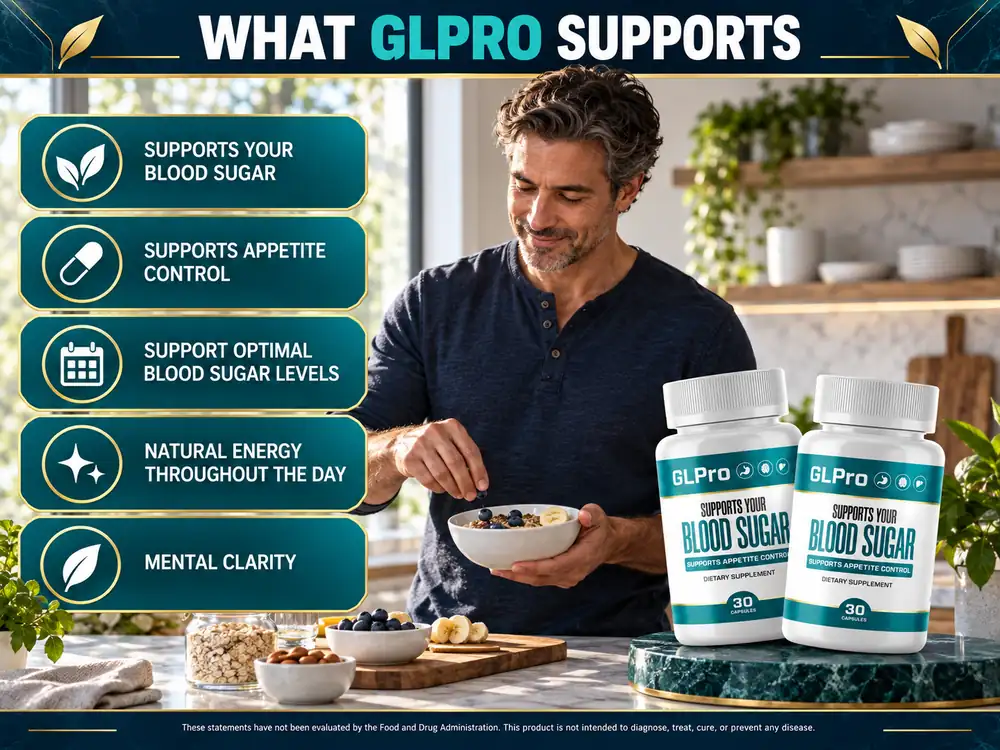
Nothing online names them. The seller's only public statement is a phrase on the sales page, a proprietary blend of natural ingredients, with no names, no amounts and no total weight. The real list sits on the Supplement Facts panel on the back of the bottle. Any website that lists GLPro ingredients for you is guessing.
- Ingredient names, amounts and blend total are not published online.
- Capsule shell, other ingredients and allergen statement are not published online.
- The Supplement Facts panel is on the bottle, which is where the formula first becomes readable.
- Studies on common blood sugar ingredients cannot be attributed to GLPro.
- Lot GLP-26/GL-3074 is a batch reference, not a laboratory result.
General information, not medical advice. GLPro is a dietary supplement. It is not a drug, it is not a GLP-1 medicine, and it is not FDA approved. No supplement is. It is not a treatment for diabetes, prediabetes or any other condition. Take medical questions to your doctor or pharmacist, and do not change a prescribed medicine because of a supplement.
Why do searches for GLPro ingredients turn up guesses?
When a product hides its list, other pages fill the space. They name berberine, cinnamon, chromium or whatever is common in the category. Some sound sure of themselves. None has a source.
The seller's material says no such thing. Any summary that says GLPro contains a named ingredient is inventing it. That includes searches such as "GLPro berberine". This page names none and estimates none, because a guess printed here would become a fact someone repeats.
What exactly has the seller said?
Very little. The sales page uses one phrase, "a proprietary blend of natural ingredients". A formula box in the seller's listing artwork says only "capsule dietary supplement". The product notes supplied to this desk are blunter still: no ingredient is named.
- Form: capsule.
- Quantity: 30 capsules in each bottle, sold for 30 days.
- Front-label claims: Supports Your Blood Sugar; Supports Appetite Control.
- Origin: the seller says it is made in the USA, using ingredients bought from around the world.
- The word natural: it has no regulatory definition for supplements.
What does a proprietary blend let a seller hold back?
A proprietary blend is a group of ingredients printed under one name with one combined weight. The FDA's labeling guide says a bottle must still show the blend's name, its total weight and each ingredient in it, heaviest first. What may be left off is the weight of each single ingredient inside it.
So even on a bottle, a blend names everything inside. With GLPro the hole is bigger, since the seller's online material skips ingredient names, not only amounts.
| Item | Status online |
|---|---|
| Blend name | Not published |
| Total weight of the blend | Not published |
| Each ingredient's name | Not published |
| Each ingredient's amount | Not published |
| Capsule shell and other ingredients | Not published |
| Allergen statement | Not published |
| Serving size | Not published |
| Capsules per bottle | 30 |
| Lot / certificate reference | GLP-26/GL-3074 / GLP-3074-26-GL |
Does GLPro contain berberine, cinnamon or chromium?
GLPro does not say. These three are common in blood sugar formulas, which is why people ask. Research on them exists, but it describes named substances at stated doses in people who often had type 2 diabetes. GLPro is sold to healthy adults, and its formula is hidden, so none of that research can be used as evidence about the capsule.
One example shows why the panel matters. Berberine is common in the category. In a 2012 paper, Guo and colleagues found that repeated doses lowered the activity of several enzymes the body uses to clear everyday drugs. We do not say GLPro contains it. We say that is the kind of line a pharmacist looks for.
Our ingredients and evidence article takes the category further.
How do I read the ingredient side of the panel when it arrives?
- Find the blend line. A heading such as proprietary blend, with one weight beside it.
- Copy the names beneath it, in order. The first is present in the largest amount.
- Note any line that has its own amount. Only those can be set beside a research dose.
- Read the other ingredients line. It names the capsule shell and any fillers.
- Check every name against your medicines, supplements and allergies. A match is a reason to stop before the first capsule.
- Photograph the panel and show it, with your medicine list, to a pharmacist.
What should I ask a pharmacist about the panel?
A pharmacist can set an unfamiliar panel beside your medicine list in a few minutes, and a chat costs nothing. Carry the real bottle so the back can be read. Then put four plain questions to them.
- Is any name on this panel known to clash with something I take?
- Could it nudge my glucose enough to matter next to my current treatment?
- If I already test my glucose, should I test more often early on?
- What signs would tell you to stop it and ring you?
Their answers outrank anything on a retail website. We can read out what the label says. Only they can say what it means for you.
Why do the capsule shell and the seals matter?
The seller's artwork carries seals reading Vegetarian, Naturally Gluten Free, Dairy Free, GMO Free and 100% Natural Ingredients. None of them can be checked online, because no ingredient list, capsule shell or allergen statement is published. The vegetarian seal depends on the shell, which could be gelatin or plant-based.
If you avoid an ingredient for allergy, dietary or faith reasons, treat the seals as unverified until your own panel confirms them.
What would change this page?
- A published panel. Every name would go on this page in the panel's order, with amounts where printed.
- A photograph from a buyer. A clear picture of the back of a bottle, sent to [email protected], would let the page print the panel, dated and matched to its lot.
- A laboratory report. The certificate reference GLP-3074-26-GL is a filing number. A report naming a laboratory and its results would be published in full.
Frequently asked questions
What are the ingredients in GLPro?
Nothing online names them. The seller's sales page offers the phrase "a proprietary blend of natural ingredients" and then stops: no name, no quantity and no blend weight follows. The list is on the Supplement Facts panel on the bottle.
Does GLPro contain berberine?
GLPro does not say. Nothing the seller publishes confirms or rules out berberine or any other named ingredient.
Where is the GLPro supplement facts panel?
On the back of the physical bottle. A copy is not published online.
Is GLPro vegetarian, gluten free or dairy free?
The seller's artwork carries those seals, but they cannot be checked online because the capsule shell and ingredients are not published. Check your own panel.
Can I use studies on other ingredients to judge GLPro?
No. A study describes a named substance at a stated dose. GLPro publishes neither, so no study can be attributed to it.
What should I do if my panel differs from this page?
Photograph it and email [email protected]. The page will be corrected and its review date moved forward.
Our view
A missing ingredient list is the biggest gap on this product, and we say so plainly. It does not forbid a purchase. It moves the checking to the day the bottle arrives, when you can read the panel and show it to a pharmacist.
If you must know every ingredient before you pay, because of an allergy, a diet rule, a sport test or a medical condition, wait or choose a product that publishes a panel. If you are willing to check on arrival, the 60-day window gives you room. Glprodaily earns money from orders, so make that call with a clear head.
Sources named in this article
- U.S. Food and Drug Administration. Dietary Supplement Labeling Guide. https://www.fda.gov/food/dietary-supplements-guidance-documents-regulatory-information/dietary-supplement-labeling-guide
- Guo Y, Chen Y, Tan ZR, Klaassen CD, Zhou HH. Repeated administration of berberine inhibits cytochromes P450 in humans. Eur J Clin Pharmacol. 2012;68(2):213-7. https://pubmed.ncbi.nlm.nih.gov/21870106/
- National Center for Complementary and Integrative Health. Using Dietary Supplements Wisely. https://www.nccih.nih.gov/health/using-dietary-supplements-wisely
Last updated October 29, 2026. Published October 16, 2026. Medically reviewed October 16, 2026.